


Our company is proud of being the owner of the 100% of its technology.
This is possible thanks to the fact that all essential components are internally produced through high-level production and quality processes.
Proof of this is the production of the screw elements that compose the extruder screws in their entirety, the barrel and – above all – the manufacturing of the gearboxes.
Particular attention is paid to the search for new construction materials to be used to improve our extruders performances.
The result is an extruder whose strength lies in its versatility and that allows it to be fit for a wide range of production layouts typical of the most varied compounding production types.
Production flexibility is our motto to provide our customers with tailor-made solutions.

Our die is defined as a ‘quick-change’ die, as disassembly takes place by loosening – but not removing –
the fixing screws.
In this way, there will be no hot parts to handle and it will be possible to change the final part by lifting it from the special handles and by replacing it according to cleaning needs or the necessity to change the strands number or size to be obtained.
In case of extraction of the extruder screws, a hinged system is present and it can be opened in order to allow – only by extracting some of them – a quick access to the tips.
Therefore, only four screws will require handling and there will be neither hot parts nor a certain weight to support.
Another significant aspect is the side heating of the die. In many cases –and above all with the new high-productivity machines – the supply chain is very wide and implies the possibility to reach different temperatures according to the various areas, which – in turn – generate irregular flows with consequent strands of different diameters. There are also heating elements places laterally to allow to vary the heating and to compensate for this phenomenon.
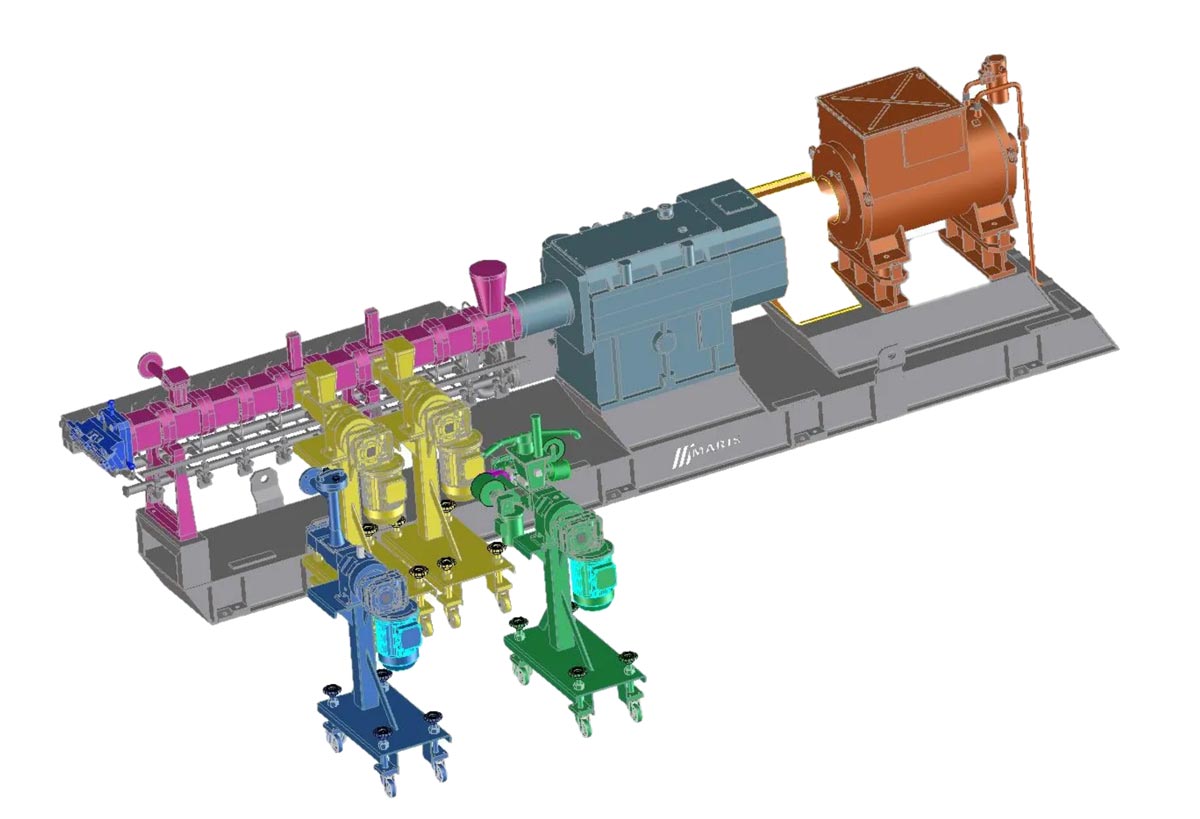
The barrel – which represents the process area – is set up by using different modules with different functionalities.
From a construction point of view, they are available in two geometric shapes: round or square.
Different shapes also determine the use of various types of electrical heating elements. In the case of a round shape, ceramic or cast (aluminium, steel or bronze) heating elements can be used, while candle or cast heating elements (aluminium, steel or bronze) can be used for the square barrels.
With regards to the construction materials – according to the applications – there are more options: from the nitrided barrel to the barrels with removable inserts in special anti-wear, anti-corrosion steels or even the combination of the two properties. These steels range from fully-hardened materials to HIP and bimetallic materials: we are always at the forefront in the research for new materials to improve our extruders performance.
Inside the barrels, you can find the screws, consisting of two shafts and modular screw elements. These elements are made with the same steels used for the barrels and can have multiple geometries and functions: transport, kneading and special elements.
Our gearboxes are manufactured and designed in-house.
Co-rotating twin screw extruders require special gearboxes able to transmit the high torque density required by this type of machines.
The gearbox is designed using drawing and calculation programs, which allow to obtain the expected results and withstand the stresses to which it is usually subjected. The design is carried out by calculating the parts in real dimensions and on three-dimensional models.
These are special gearboxes where the motion is divided among various power branches and re-joined to be able to transmit the power to the two screw shafts. This gives life to a very complex gearbox with special devices and adjustments to ensure that each screw shaft receives exactly half of the power.
The high torque density requires the use of advanced materials and treatments that must be monitored.
By producing the parts entirely – manufacturing and processing them in-house – we can evaluate all aspects of the manufacturing process.
In the same way, all the gearboxes are dimensionally inspected by our internal testing.
The lubrication system – which carries the oil to each part – is placed outside the gearbox and it is provided with sensors to prevent any malfunction from damaging the gearbox.
Our company always places extreme care in choosing the motor to install on its machines.
The motor supplied can be of different type, such as:
DC motor with various degrees of protection according to its application
The motor is equipped with temperature sensors, encoders for more accurate speed control and –
in the case of water-cooled motors –
a system that checks temperature and flow. In addition, the system is equipped with a solenoid valve and a filter to prevent foreign particles to enter the motor.
A torque limiter is inserted between the motor and the gearbox to eliminate overloads, which can be arising from possible screws locking while preserving the gearbox. These devices – purchased externally – are however analysed together with the supplier and customized according to their use. The uncoupling of the limiter, which completely zeroes the torque, is signalled by a microswitch that stops the motor to prevent the torque generated by the motor due to inertia from discharging on the gearbox.
The side degassing system is a device used to optimize atmospheric degassing /venting throughout the extrusion process. Some processed materials, in fact – due to their specific rheological features – can cause clogging of the standard degassing chimney, thus preventing the correct devolatilization of the gases. In these cases, it is necessary to use the side degassing system, where the degassing chimney is assembled on a twin-screw device, which guarantees high volumes of devolatilization, while avoiding any clogging, material stagnation or pollution due to the degraded polymer.
The side degassing device is therefore composed of a housing and a pair of co-rotating transport screws very similar to the side feeding machines, but the standard hopper has been replaced by a chimney. The hermetic seal guarantees a correct seal during operation with vacuum levels commonly used in compounding processes.
The twin-screw side feeder is a device that allows the feeding of materials through the extrusion process. Materials introduced can be additives, polymers, resins or fillers, either in form of powders, granules or fibers.
Its use – according to formulations –
is recommended when it is necessary to increase the percentage of a filler, the production capacity and – in some cases – the quality of the compound produced. The number of side feeders used varies according to the formulation and the process, from one in case of standard compounds up to three for highly filled compounds (e.g. polyolefins with 86% CaCO3).
The deaeration system is a piece of equipment patented by Maris that allows to improve the feeding capacity of some types of powders in the extrusion process.
The goal is to increase the material bulk density by removing the air contained in the powders (fillers).
Its function lies in the use of a vacuum action on a porous filtering surface that allows the removal of the air contained in the fillers to be fed into the extruder.
Resorting to this technology –
if compared to a standard side feeder – can increase the screws filling and, consequently, the production capacity, while reducing the specific energy and –
therefore – the energy consumption or, more generally, obtain a reduction in the production costs.
Personal data entered are processed by the owner of the website Maris Fratelli Spa – Corso Moncenisio 22 – 10090 Rosta (TO) – +390119567925 acting as Controller, for purposes associated with the provision of the services requested by You (without limitation: asking information, registering to the website to receive advantages and offers, obtaining quotations, making payment, purchase goods and receiving them at the address specified by You, making a reservation, exchanging documents).
Furthermore, the data provided by You, could be processed, on Your explicit consent only, for the purpose of sending business communications, by email o by text, concerning services provided by the Controller.
Processing operations will take place with electronic mode and will be made available to third parties (External Processors) inside and outside the EU, duly contracted and offering adequate security safeguards, necessary for the provision of essential services to satisfy Your needs. Said External Processors – whose list is available upon request – may belong to categories of people supporting the Controller in the delivery of the services offered through this website (such as, without limitation: software developers and website managers, carriers).
Furthermore, they will be processed for statistical analysis and direct marketing purposes – on an anonymous basis – as better specified in the cookie policy.
Accordingly, they are legitimate processing operations necessary to ensure a service meeting Your expectations. Data will be stored for the entire term of the services requested by You or for longer periods only where provided for by the Law. At any time, You may exercise the rights provided for by articles 15 – 22 of GDPR by writing to the Controller of the present web site.
In order to rectify or erase your personal data stored in the system used to supply the present web site, click here. The personal data You will insert in the form (including you email address) should be communicated to a company that acts as Processor on behalf of the Controller and that manage the website and the users’ requests.
Should You ask for Your data to be erased, we inform You that it may no longer be possible to continue providing You with the service requested.
Finally, we inform You that You can lodge a complaint with the Data Protection Authority if You believe Your rights have been violated.
***********************************
COOKIE POLICY
This Site uses technical cookies (i.e., necessary cookies) and with your consent also analytical and profiling cookies, which we and third parties will use – respectively – to enable certain key features of the Site, to obtain measurements of the Site performance or to provide you with promotions in line with your interests.
To accept, reject or select cookies according to purpose, use the controls in the cookie management pop-up banner.
In particular, to find out which cookies are installed within the preset site and express your preferences in this regard, select the ‘Settings’ command where you can also view the individual cookies issued in each category. To select the purposes you are interested in, use the box in the banner, and click on “Customise” to confirm your preferences.
Your preferences will be recorded in a Cookie Consent Management Platform (the “CMP”), which has been developed in accordance with the principles of the applicable data protection legislation and according to the privacy guidelines in order to allow you to exercise your choices in a granular manner. CMP allows you to give or to reject your consent to various types of cookies, which are identified and categorised according to the purposes for which the cookies are issued and used, making it easier and more straightforward to recognise them.
You may at any time withdraw or modify the consent given by clicking on the relevant CPM access icon that will appear on the Site. This icon will be displayed in the bottom left-hand corner, once you have expressed your preferences via the pop-up banner displayed when you access the Site.
The cookies used on this Site fall into the categories described below.
What are cookies
Cookies are small text files that are automatically placed on the user’s PC within the browser. They contain basic information about your Internet browsing and are recognised by your browser each time you visit the Site.Below you will find details of the cookies installed by this website and how to manage your preferences.
What cookies are for
Cookies are useful since they allow us to store your browsing preferences and thus customise the Site according to your needs by improving your browsing experience. For example, cookies can make the use of the Site more immediate and/or enable certain functionalities. For example, cookies may make it possible to avoid re-entering the same information several times during a visit. In certain cases, cookies may also make the advertisements displayed online more appropriate to the user or relevant to the user’s interests.Some cookies are necessary for the correct delivery of the Site or useful for a personalised use of the Site. In this case, their inhibition could compromise certain functionalities of the Site. Moreover, thanks to cookies, advertisements in line with your interests – cleared of your online activities and browsing habits – can be published on the Site itself, directly or through third parties.
Which categories of cookies are used on the Site
1 – Technical or necessary cookies:
the technical cookies described below do not require consent and are therefore installed automatically following access to the site.
– Cookies necessary for operation: cookies that allow the site to function properly, including allowing the user to have a functional browsing experience. For example, they keep the user logged in while browsing by preventing the site from requiring the user to log in several times to access subsequent pages.
– Statistical and Audience Measurement cookies: cookies that help understand, through data collected in an anonymous and aggregate form, how users interact with the Website by providing information about the sections visited, the time spent on the site, any malfunctions.
For instance, in some cases, Google Analytics cookies used by this site have been anonymised and are therefore equivalent to technical cookies.
2 – Functional Cookies
This category includes cookies that allow us to remember preferences you have selected while browsing, for example, they allow you to set your language. These cookies are only issued at the request of the user and with their prior consent. The user is free to give his or her consent to the installation of functional cookies and to withdraw it at any time, through CMP, without the possibility of visiting the Site and enjoying its contents being affected. However, if the user does not consent to these cookies, the use of certain functionalities may be affected.You can access the CMP at any time through the icon on the Site, where you will find a summary of the consents released that you can modify by clicking on the ‘Modify Consent’ button; at this point a screen will open allowing you to modify your preferences by choosing the categories of interest and with the ‘Settings’ button you can find out which functional cookies are released on the Site, their purpose and duration. Once you have made your choice, click on the ‘Customise’ button to confirm it.
3 – Analytical Cookies
Cookies in this category are used to collect statistical information, in non-aggregated form, on the use of the Site by users accessing the Site and on the way in which they navigate on the Site. As required by applicable Law, the prior consent of the user is required for the installation of third-party analytical cookies. If you give your consent to the installation of analytical cookies, the Controller will keep track of this consent by means of a specific technical cookie. In this way, it will be possible to avoid the repetition of the cookie banner during future visits to the Site. You can access the CMP at any time through the icon on the Site, where you will find a summary of the consents released which you can modify by clicking on the ‘Modify Consent’ button. At this point, a screen will open that allows you to modify your preferences by choosing the categories that interest you, and through the ‘Settings’ button you can find out which analytical cookies are released on the Site and thus obtain all the necessary information. Once you have made your choice, click on the ‘Customise’ button to confirm it.
4 –Profiling Cookies
Profiling cookies are used to group users into homogeneous categories based, for example, on user preferences. Such cookies can be used – among other things – to send advertising messages in accordance with the user’s online behavior and browsing interests. In accordance with applicable Law, the prior consent of users is required for the installation of profiling cookies. The user is free to give his or her consent to the installation of profiling cookies and to withdraw it at any time – through CMP – without the possibility of visiting the Site and enjoying its contents being affected. In the event that the user gives his consent to the installation of profiling cookies, the Data Controller will keep track of this consent by means of a specific technical cookie. In this way, it will be possible to avoid the repetition of the cookie banner during future visits to the Site.Profiling cookies are installed by the Data Controller and by third parties acting as independent data controllers (third-party cookies).You can access the CMP at any time through the icon on the Site, where you will find a summary of the consents issued that you can modify by clicking on the ‘Modify Consent’ button. At this point a screen will open that allows you to modify your preferences by choosing the categories you are interested in and via the ‘Settings’ button to obtain more information on the third parties that install profiling cookies, on the individual cookies issued and on their duration. Once you have made your choice, click on the ‘Customise’ button to confirm it.
In addition, by going http://www.youronlinechoices.com/it/le-tue-scelte you can find out about behavioral advertising as well as deactivate or activate the cookies of the listed companies that work with website operators to collect and use information for advertising.
Remember that you can also manage your cookie preferences via your browser.
Below, you will find more detailed instructions on how to manage cookies for the most popular browsers.Browser manufacturers may update or change the references in the links below from time to time, so please always check the instructions provided by the manufacturers of the browsers you use to understand how to set cookies.
If you use the Edge browser:
• You can find out how to manage cookies, delete them, block them, select them by using the settings of this browser at the following link: https://support.microsoft.com/it-it/microsoft-edge/eliminare-i-cookie-in-microsoft-edge-63947406-40ac-c3b8-57b9-2a946a29ae09.
If you use the Firefox browser
• To find out how to manage cookies via this browser settings: https://support.mozilla.org/it/kb/Gestione%20dei%20cookie.
• To learn how to manage the privacy settings panel and inhibit the tracking of your online activities https://support.mozilla.org/it/kb/Impostazioni%20di%20Firefox%20-%20pannello%20Privacy.
• To find out how to activate and deactivate cookies: https://support.mozilla.org/it/kb/Attivare%20e%20disattivare%20i%20cookie.
• To find out how to delete cookies: https://support.mozilla.org/it/kb/Eliminare%20i%20cookie.
• To find out how to block cookies: https://support.mozilla.org/it/kb/Bloccare%20i%20cookie.
• To find out how to deactivate only third-party cookies: https://support.mozilla.org/it/kb/Disattivare%20i%20cookie%20di%20terze%20parti.
If you use the Safari browser
• To find out how to manage cookies via this browser settings: https://support.apple.com/it-it/guide/deployment/depf7d5714d4/web.
If you use the Google Chrome browser
• To find out how to manage cookies via this browser settings: https://policies.google.com/technologies/cookies?hl=it&gl=it#managing-cookies.
• To find out how to activate private browsing mode: https://support.google.com/chrome/answer/95464?hl=it.
• To find out how to delete cookies, block them selectively if necessary, receive notifications about your cookie settings: https://support.google.com/chrome/answer/95647?hl=it.
Last updated: 08/06/2023.